

Best nurse call system ensures accurate and timely communication. One of the most crucial factors affecting system performance is a reliable wireless signal. Complex medical facilities present significant communication challenges, which is why we at Caretronic have built our solutions around a robust communication infrastructure. Signal strength testing is paramount when implementing hospital nurse call systems and helps us identify coverage gaps and sources of interference.
In healthcare, innovation succeeds when it enhances communication without compromising reliability. As nurse call system manufacturers, we balance innovation with clinical stability. When managed correctly, these two priorities strengthen one another. By allowing institutions to adapt spaces, workflows, and care environments without compromising communication reliability, our solutions support flexible ward layouts and help deliver high-quality care.

Why Signal Reliability Matters in Hospital Nurse Call Systems
Best nurse call system offers medical facilities flexibility, mobility, and scalability. All of these advantages depend on clear communication to maintain operational continuity, which relies heavily on signal reliability once a nurse calling solution is integrated. Healthcare settings are particularly challenging, making signal reliability far more difficult to achieve. Hospitals, care homes, nursing homes, hospices, and clinics often contain thick reinforced-concrete walls, operating theaters, steel structures, specialized treatment rooms, and underground areas. When combined with electronic devices, medical equipment, infrastructure solutions, and the constant movement of patients and personnel, the environment is filled with potential sources of interference.
As nurse call system manufacturers, we understand how critical a strong signal is for seamless operation. When wireless signals remain stable and reliable, personnel can respond promptly and confidently. A strong signal also supports staff mobility, reduces alarm fatigue and communication uncertainty, and helps personnel manage emergencies effectively. Our NurseCare solution demonstrates how wireless technology can strengthen operations when implemented correctly.
How Nurse Call System Manufacturers Ensure Reliable Coverage
The best nurse call systems must be thoroughly tested before installation, along with their signal performance, to ensure proper functionality. A reliable signal enables seamless communication between patients and caregivers, ensuring timely responses and efficient care coordination. It must also provide flexibility across different healthcare settings and allow institutions to tailor functionality to their specific clinical requirements. Signal strength testing measures wireless coverage throughout a facility before a wireless nurse call system is installed.
To protect safety, nurse call system manufacturers must identify and eliminate coverage gaps before the solution becomes operational. Coverage gaps are areas where wireless signals are weaker than required for dependable communication. Resolving these issues to support personnel mobility may require additional equipment, infrastructure modifications, or operational adjustments. Testing provides valuable information for installation planning and helps determine the optimal locations for wireless components. This planning process reduces uncertainty, improves communication efficiency, supports scalability, and helps minimize future costs.

How Nurse Call System Manufacturers Support Long-Term Reliability
Best nurse call system must perform flawlessly in a rapidly evolving healthcare environment. Innovation drives progress by enabling faster communication, better data management, greater flexibility, and a richer patient experience. However, healthcare environments must also perform consistently around the clock, which is why we design products that maintain a unique balance between innovation and clinical stability. Clinical stability means that equipment performs consistently in real-world conditions, but on its own, it is not enough to meet modern healthcare demands.
Development begins with clinical requirements. It is essential that manufacturers understand these workflows before introducing new features. At Caretronic, we always design hospital nurse call systems around practical healthcare challenges. Our devices enhance proven technologies rather than replacing them entirely. They minimize operational disruption through seamless integration with existing equipment, creating a dependable communication infrastructure.
Innovation Cycles in Nurse Call Manufacturing
Best nurse call system is often defined by its new features, advanced technologies, and modern interfaces, yet innovation follows a structured development cycle. As manufacturers, our role is to continuously evaluate clinical needs, develop new concepts and features, test solutions, gather feedback, and refine technologies. Development in nurse call manufacturing follows recurring cycles that drive continuous improvement. These cycles influence software evolution, hardware development, communication technologies, cybersecurity, user experience, workflow optimization, integration capabilities, and long-term planning.
Innovation is a continuous process that supports evolving healthcare needs. Development cycles matter because they allow technology to adapt to changing clinical requirements. This adaptability contributes to better care delivery and creates long-term value through sustainable innovation.
Hospital Nurse Call Systems Enable Flexible Care Environments
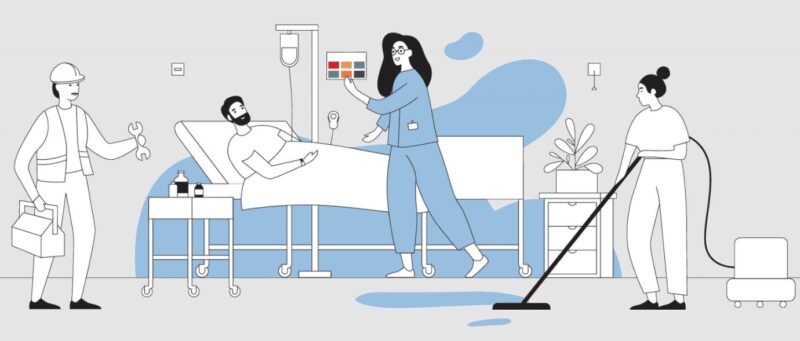
Hospital nurse call systems support flexible ward layouts by reducing reliance on fixed communication points. Healthcare environments are constantly changing due to increasing patient volumes, organizational restructuring, or the introduction of new treatment programs. The NurseCall system responds to operational demands and enables personnel to react quickly to changing circumstances. It allows facilities to maintain adaptability during renovations, create multi-purpose care spaces, strengthen infection control strategies, improve staff mobility, prevent disruption during operational changes, and optimize available space.
In today’s rapidly evolving healthcare landscape, the best nurse call system has become a cornerstone of safety, efficient communication, and high-quality care delivery. Investing in such a system not only improves operational efficiency but also enhances patient satisfaction and overall healthcare outcomes.