
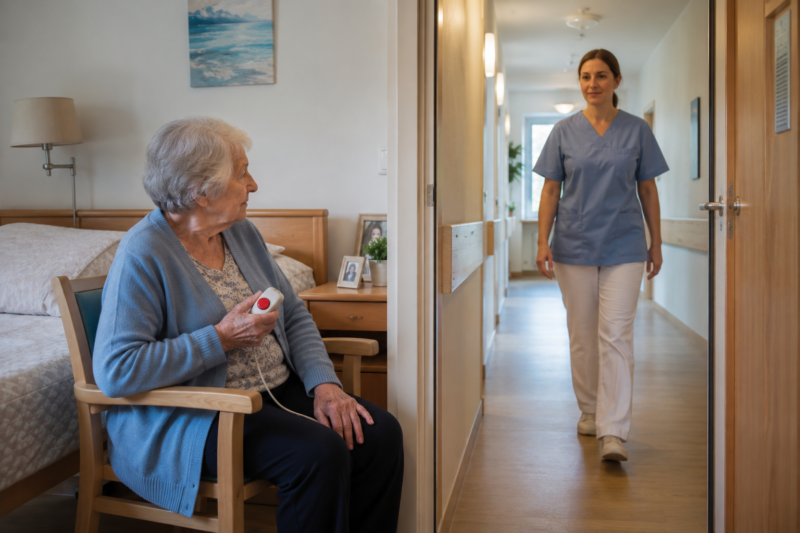
Caregivers want to spend more of their shift with patients and residents, yet much of the working day is taken up by documentation, coordination, retrieving supplies and walking between rooms and workstations. A conventional call button adds another task because it tells staff where a call came from, but not why the person called. NurseVoice, an AI feature on Caretronics Nurse CalNurse call system with AI technology can help caregivers spend more of their shift with patients and residents, rather than on documentation, coordination, retrieving supplies, and walking between rooms and workstations.
A conventional nurse call button adds another task because it tells staff where a call came from, but not why the person called. NurseVoice, an AI assistant within our smart nurse call system, can ask the patient or resident a short series of questions when a call is made. The care team receives the reason for the call and can prepare a more appropriate response, while the nurse remains responsible for every care decision.l System, can ask the patient or resident a short series of questions when a call is made. The care team receives the reason for the call and can prepare a more appropriate response, while the nurse remains responsible for every care decision.
Healthcare Has Changed - Nurse Call Systems Have Not
Healthcare providers all over the world in all types of facilities face similar problems. Populations are ageing, needs and requirements are becoming more complex and experienced staff are difficult to recruit and retain. At the same time, regulations and bureaucracy continue to grow.
The answer cannot be to keep adding disconnected tools to an already fragmented working day. Replacing an old nurse call button with a newer version of the same blind button does not change the process. It still sends an alert without explaining whether the patient needs water, feels cold or may need urgent help. Facilities need technology that removes unnecessary work and gives staff useful information earlier. A nurse call system with AI can contribute to this goal instead of adding to the issue.
The Growing Gap Between Caregiving and Administration
Every caregiver would prefer to spend most of the shift at the bedside. The reality is different. Time-and-motion studies from different clinical settings have reported that direct patient care can account for only around 19 to 38 percent of observed nursing time, depending on the ward, role and research method.[1][2][3]
This is not a universal average for every hospital. It is a range across individual studies, but it illustrates a consistent operational issue: a considerable part of the shift takes place away from the patient or resident.
The rest of the working day includes necessary indirect care and a range of supporting tasks:
- retrieving and preparing supplies;
- coordinating with colleagues and other departments;
- documenting care and entering data;
- finding information in different systems;
- managing schedules, calls and handovers; and
- walking between rooms, workstations and storage areas.
Much of this work is necessary, but inefficient processes make it more time-consuming than it needs to be. Staff often transfer information between systems manually, call colleagues for updates and return to central workstations to complete documentation. These tasks take valuable time away from care.
The problem usually comes from two areas: growing reporting requirements and outdated systems that do not work well together. This leads to duplicate data entry, more administration and unnecessary coordination. The impact is felt across the facility. Staff have less time to observe and speak with patients, operating costs increase and frequent interruptions add more pressure to an already demanding shift.
Nurses Are Constantly on the Move While Working Under Pressure
Walking is a basic part of nursing, but occupational movement is not the same as a walk taken for exercise or recovery. Researchers describe this distinction as the physical activity paradox. Physical activity during leisure time is usually voluntary, limited in duration and followed by recovery. Occupational activity may involve long periods of walking and standing, repeated bending or leaning, limited control over pace and too little recovery.[7]
What Studies Tell Us About Distance During a Shift
Published findings vary because hospitals, ward layouts, roles and shift lengths vary. Taken together, they show that nursing work can involve substantial distances:
- A medical-surgical nursing study recorded an average of 9,360 steps and 5.8 kilometres during an observed period of approximately 9.4 hours.[5]
- A study of intensive care nurses reported an average of 10.7 kilometres during a 12-hour shift. When the patient assignment increased from one to two patients, the reported distance reached about 15 kilometres.[4]
These figures should not be presented as a universal benchmark. A nurse in a compact care home will not follow the same movement pattern as a nurse in a large intensive care unit. However, the studies make one point clear: even small workflow inefficiencies can add up when they are repeated across a full shift.

Where Avoidable Walking Comes From
Not all movement is necessary. A blind call is a simple example. A resident presses a nurse call button because she wants a glass of water. The alert tells the nurse which room called, but not what is needed. The nurse walks to the room, asks the resident, leaves to collect the water and then returns. One simple request creates two journeys. Other avoidable steps come from returning to a central computer to document care, looking for equipment or manually checking information that could be available through connected smart nurse call systems and appropriate sensors. The goal is not to keep nurses seated. It is to reduce walking that exists only because the right information was not available at the right time.
Better Documentation Solves Part of the Problem
Our smart nurse call system approach starts with documentation at the point of care. Staff can record relevant actions where care takes place instead of returning to a central station or trying to reconstruct events later. This can reduce duplicate work and improve the timeliness of records. It also keeps documentation closer to the care process. But documentation alone does not explain why a patient or resident has pressed the nurse call button.
A conventional alert still creates uncertainty. Every call initially looks similar, although the reasons can range from a routine request to a possible clinical risk. This affects how staff prepare, prioritise and respond. It can also add to the wider problem of alarm fatigue. It has been reported that clinical environments may generate thousands of alarm signals and has warned that excessive non-actionable alarms can desensitise staff.[8] A smart nurse call system alert should provide enough information to support action, not simply add another sound.
NurseVoice adds context before the nurse reaches the room
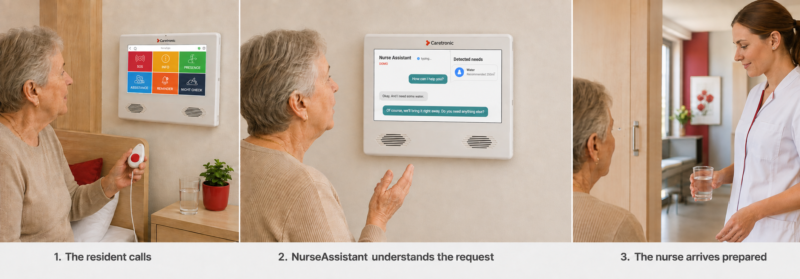
Our nurse call system with AI is integrated with NurseVoice, an AI voice feature. When a patient or resident triggers a call, the assistant starts a short, structured dialogue to identify the reason for the request. The purpose of a nurse call system with AI assistance is practical. Staff can receive initial context before walking to the room and decide what to bring, who should respond and whether the call may need faster attention.
How the NurseVoice dialogue works:
- The patient or resident activates the call.
- The assistant asks a clear question, such as, “How can we help you?”
- It uses a defined dialogue to collect the reason for the call.
- The request and available context are sent through the Smart nurse call workflow.
- A member of staff reviews the information and decides how to respond.
NurseVoice does not assess the patient, make a diagnosis or decide what care should be provided. It collects context. Clinical judgement remains with qualified staff.
A Request for Water
The resident explains that she would like water. A nurse or another appropriate team member can bring it on the first visit. The resident receives a better response and the team avoids a trip made only to collect information.
A Resident Who Feels Cold
The resident says that he feels cold. A staff member can arrive with a blanket while remaining alert to the possibility that the statement may require further assessment. The nurse call system with AI supports preparation, but it does not replace observation.
A Report of Bleeding
The patient says that she is bleeding. The wording indicates a potentially urgent situation and is passed through the configured escalation workflow. Staff determine the appropriate clinical response. The benefit is that possible urgency becomes visible earlier than it would with a context-free alert.
AI Should Support Staff, Not Work Around Them
A nurse call system with AI technology should make care more human, not less. NurseVoice was developed as part of our smart nurse call system with nurses and care organisations to reduce unnecessary work, provide useful context and give staff more time for the people who need them.
As populations age and workforce pressures grow, every minute of a caregiver’s time becomes more valuable. A modern nurse call system with AI can do more than signal that someone needs help. It can help staff understand what is needed and respond in the right way, while every care decision remains with the care team.
Technology cannot replace human care. But when it removes unnecessary steps and brings the right information to the right person, it creates more time for what matters most: being there for the patientTechnology cannot replace human care. But when it removes unnecessary steps and brings the right information to the right person, it creates more time for what matters most: being there for the patient or resident. or resident.
- Al-Moteri M, Alzahrani AA, Althobiti ES, et al. The Road to Developing Standard Time for Efficient Nursing Care: A Time and Motion Analysis. Healthcare. 2023;11(15):2216. https://doi.org/10.3390/healthcare11152216
- Antinaho T, Kivinen T, Turunen H, Partanen P. Nurses' working time use: how value adding it is? Journal of Nursing Management. 2015;23. https://doi.org/10.1111/jonm.12258
- Bakhoum N, Gerhart C, Schremp E, et al. A Time and Motion Analysis of Nursing Workload and Electronic Health Record Use in the Emergency Department. Journal of Emergency Nursing. 2021;47. https://doi.org/10.1016/j.jen.2021.03.007
- Nahk E, Frolova S. Distances covered by ICU nurses during their shifts. Critical Care. 2009;13(Suppl 1). https://doi.org/10.1186/cc7627
- Welton JM, Decker M, Adam J, Zone-Smith L. How far do nurses walk? aMedsurg Nursing. 2006;15(4):213-216. https://pubmed.ncbi.nlm.nih.gov/16999182/
- Fijačko N, Masterson Creber R, Metličar Š, Gosak L, Štiglic G. Nurses' occupational physical activity and workload in a perioperative intensive care unit in Slovenia. Preventive Medicine Reports. 2023;37:102543. https://doi.org/10.1016/j.pmedr.2023.102543
- Janssen TI, Voelcker-Rehage C. Leisure-time physical activity, occupational physical activity and the physical activity paradox in healthcare workers: a systematic overview of the literature. International Journal of Nursing Studies. 2023;141:104470. https://doi.org/10.1016/j.ijnurstu.2023.104470
- The Joint Commission. Medical device alarm safety in hospitals. Sentinel Event Alert, Issue 50. https://digitalassets.jointcommission.org/api/public/content/f65e5c9df2b94000a99445e0a7877007