

Chronic staffing shortages, increasing administrative burden which are saturating the nursing shift, and financial pressures are universal challenges recognized by everyone within the care delivery process. Currently, time is one of the most mismanaged resources in the industry. While ideally nurses spend the majority of their shifts at the bedside - focusing on patient or resident interaction, clinical assessments, and the essential human touch - the reality tells a different story. Although healthcare systems vary by region, the struggle with bureaucracy and the genuine lack of time is a shared burden.
The Breakdown: How do nurses spend their shifts?
While the fundamental mission of any healthcare institution is the delivery of direct care, the modern nurse’s shift is increasingly dominated by activities that occur far away from the bedside, thus creating a paradox. Whether operating within a modern nursing home, high-tech medical center or in a busy public hospital, the evidence is consistent across the United States, the European Union, and beyond: nurses are currently only spending an average of 19-38 % of their nursing shift on direct care*. The remainder is swallowed by “time-thieves”:
- getting supplies
- manual coordination and logistics
- administrative work
- documentation and logging
- professional communication
- etc.
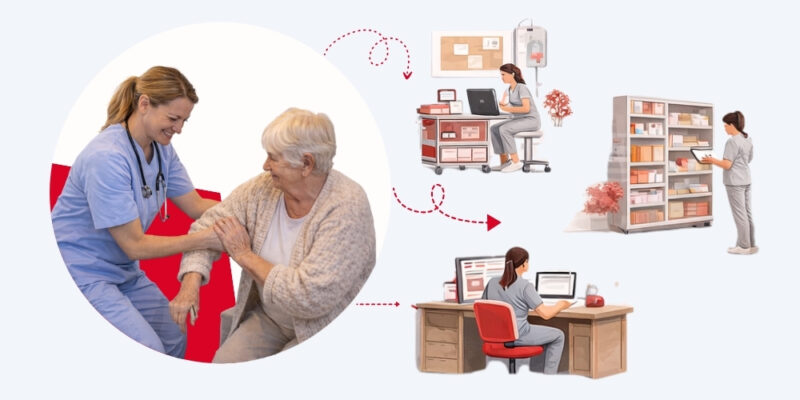
A significant portion of nursing time is consumed by logistics and manual coordination. This includes retrieving supplies, coordinating with other departments and managing schedules. These time-consuming tasks could be performed by automated systems - yet the lack of technology means that staffing and scheduling is often handled via phone calls, emails and spreadsheets, placing a massive administrative burden on qualified members of the team.
The patient and resident care imbalance
The manifestation of the bedside time crises and nursing shift paradox varies significantly between regions, but the root causes remain consistent:
- Regulatory Complexity: A massive administrative load fueled by increasingly strict reporting and compliance rules.
- Old Technology: A lack of integrated systems that forces staff to manually sync data between disconnected platforms and legacy systems.
This isn’t just a minor inconvenience—it’s a daily reality with serious consequences. It compromises patient and resident safety by cutting into observation time, drains institutional budgets through wasted labor, and threatens the long-term survival of our workforce by fast-tracking burnout. We are witnessing a dangerous paradox: the most critical, high-value healthcare work is being sidelined by necessary, but exhausting, indirect labor.
Healthcare paradoxes:
- Skilled nursing facility sector is increasingly tilted away from professional nursing
- Majority of workload in the nursing shift is about documentation and administration
- Highly trained nurses are most likely to handle documentation instead of direct care
- Physical layout and transition to single-occupancy rooms have an impact on nursing efficiency
Optimizing The Nursing Shift for Direct Care
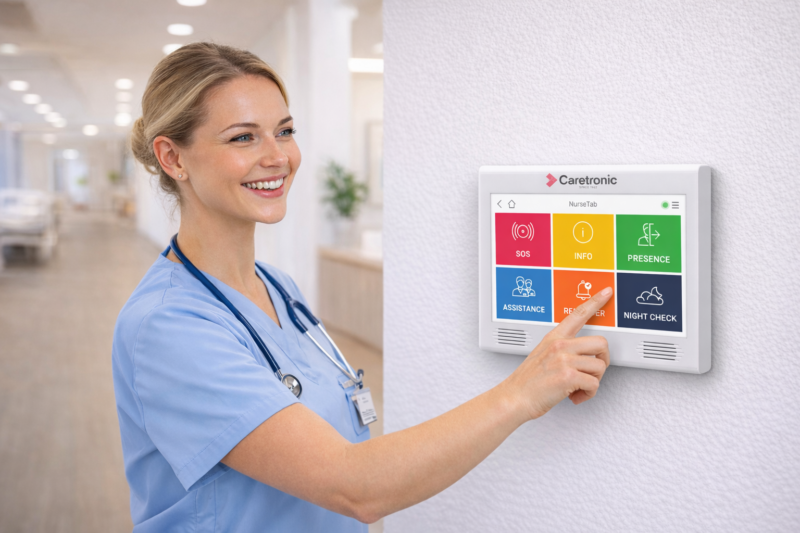
To protect the future of care, it isn't enough to simply acknowledge the daily obstacles your staff faces. It’s time to build the digital and physical ecosystems that solve them. At Caretronic, we see your nurse call system as more than just a communication tool—it is the workflow engine designed to stop the "time-thieves" slowing down your facility.
Here is how you can directly reduce the administrative burden and return your focus to healthcare:
➡️ Stop the "Double-Logging" Drain
Does your staff perform a task at the bedside, only to walk back to the nursing room to record it later? This traditional "double-logging" is a source of wasted time and potential error.
- The Solution: Bring administration directly to the bedside. By allowing your team to log services and measurements on the spot, you ensure documentation happens in real-time. This seamless digitization eliminates the need for nurses to spend their final hours "catching up" on paperwork at a crowded nursing room.
➡️ Turn "Blind Calls" into Actionable Insight
In many facilities, a "call" is just a generic buzzer—a sound that forces a nurse to stop their current task and walk to a room just to identify the need. This "blind response" model is a leading cause of staff fatigue.
- The Solution: Transition to a context-driven workflow and tilt the nursing shift back to care. Your team deserves a system that provides more than just a room number; they need insight. With NurseCare, your staff is empowered to:
- Prioritize instantly: Distinguish between a routine request and a high-risk emergency before leaving their current task.
- Work smarter, not harder: Leverage AI-supported technology to transform how your ward operates, shifting from reactive chaos to proactive care.
Is your facility ready to flip the paradox?
By streamlining these exhausting, time-consuming tasks, you aren't just improving efficiency - you are restoring the professional dignity of your clinicians. When you remove the friction of legacy technology, you give your team the freedom to focus on their true calling.
* Al-Moteri M, Alzahrani AA, Althobiti ES, et al. The Road to Developing Standard Time for Efficient Nursing Care: A Time and Motion Analysis. Healthcare (Basel). 2023;11(15):2216. Published 2023 Aug 6.
Antinaho, Tuula & Kivinen, Tuula & Turunen, Hannele & Partanen, Pirjo. (2014). Nurses' working time use – how value adding it is?. Journal of Nursing Management. 23. 10.1111/jonm.12258.
Bakhoum, Nicole & Gerhart, Christian & Schremp, Emma & Jeffrey, Ashley & Anders, Shilo & France, Daniel & Ward, Michael. (2021). A Time and Motion Analysis of Nursing Workload and Electronic Health Record Use in the Emergency Department. Journal of Emergency Nursing. 47. 10.1016/j.jen.2021.03.007.