
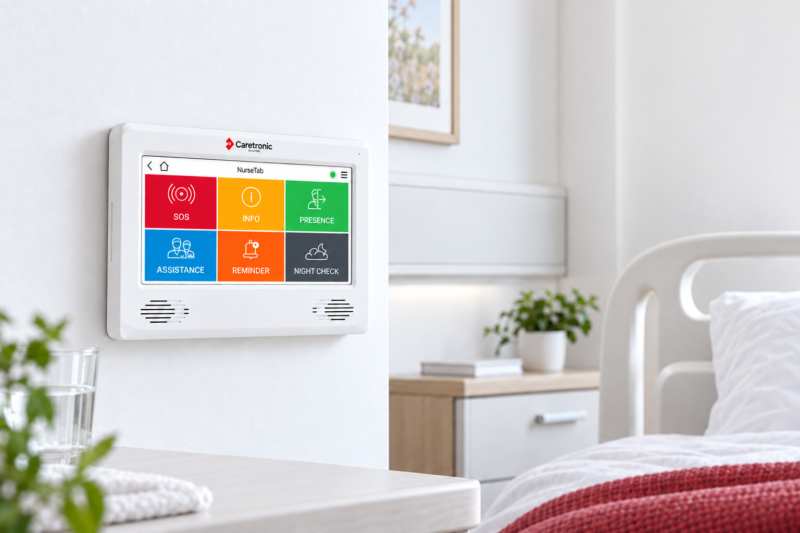
Nurse solutions are essential in hospitals, care homes, and care facilities, giving patients and residents a direct way to request assistance from their caregivers. A nurse call system helps staff respond to requests, manage urgent situations, and provide safer care. Its role is to support reliable communication between patients and care teams whenever assistance is needed.
Its basic role is not open to debate. A call must be triggered immediately, reach the right staff and remain reliable when it matters most. The more difficult question is what else the system should do.
The market for nurse solutions includes several long-established providers. Many offer safe, certified and proven systems. They are familiar to planners, technical teams and decision-makers, and often appear first on a project shortlist for good reason.
However, choosing a familiar name does not automatically mean choosing the hospital communication system that best supports the next 10 or 15 years of care. Healthcare organisations now need to consider not only calls and alarms, but also documentation, integrations, staff workload, operational data, new safety functions and the ability to adapt nurse solutions over time.
This is where NurseCare is different. It protects the essential function of the call while providing a wider foundation for digital care.
Planning a new installation or replacing an existing system? Compare the complete workflow, not only the call buttons and room hardware.
Today’s Care Environments Require More from a Nurse Call System
Traditional providers have built their position through reliability, compliance and years of experience. Modern nurse solutions from established brands may also include IP networking, mobile notifications, reporting and interfaces to external systems. The real distinction is therefore not simply “old versus new” or “safe versus unsafe”. It is how the complete solution is structured.
In many conventional projects, nurse call remains the central product while additional capabilities are supplied through separate modules, software packages, third-party systems or certified integration partners. Each component may work well, but the organisation can still end up managing several interfaces, contracts and data sources.
NurseCare was designed as a modular IP platform. Nurse call is its safety-critical foundation, while documentation, reporting, sensors, mobile communication and advanced software functions can be added around the same hospital communication system. The aim is not to make the call less important. It is to make the information and workflows that follow the call more useful.
More Than a Call: One Platform for Everyday Care
A basic nurse call system answers two questions: where did the call come from, and what priority it has. That is essential, but it does not always tell staff what the person needs or what should happen after the response.
Modern nurse solutions should support the wider process:
- A patient or resident calls for help.
- The call is sent immediately according to the facility's configured workflow.
- Staff receive the available context and respond.
- Presence, response and relevant care actions can be recorded.
- Managers can review call activity, response times and workload patterns.
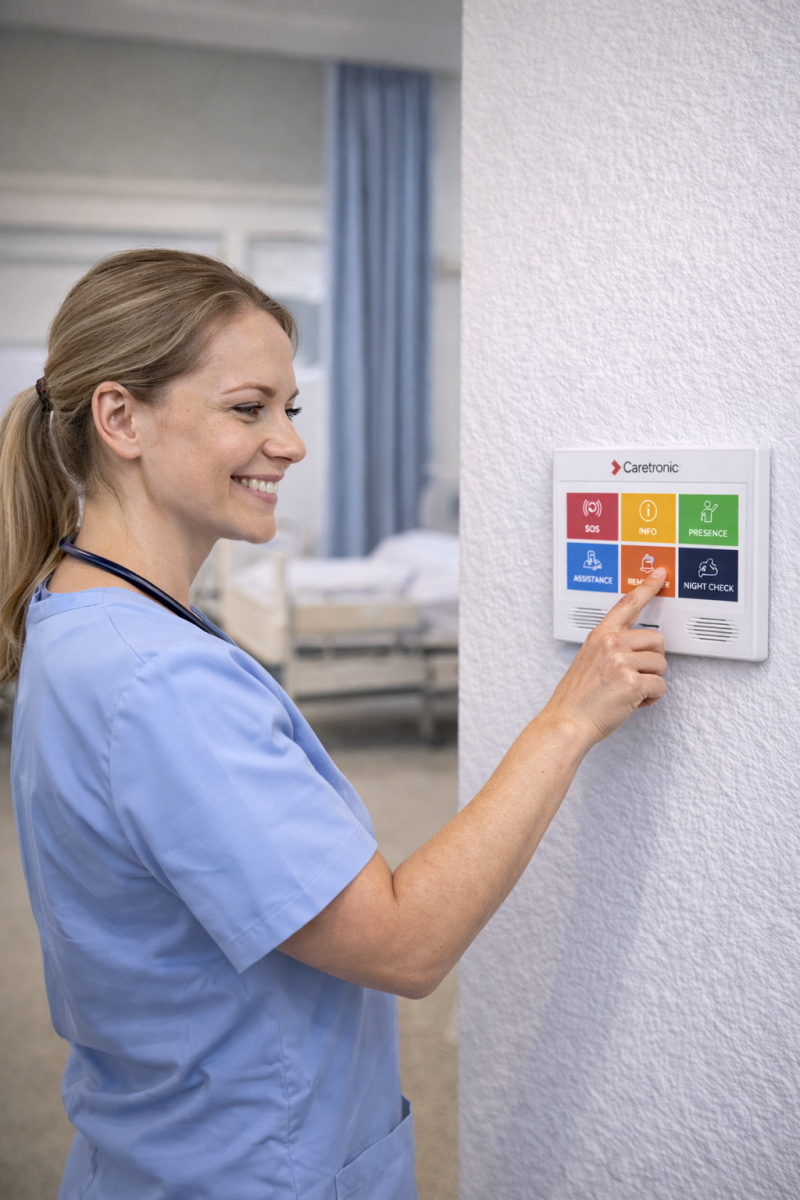
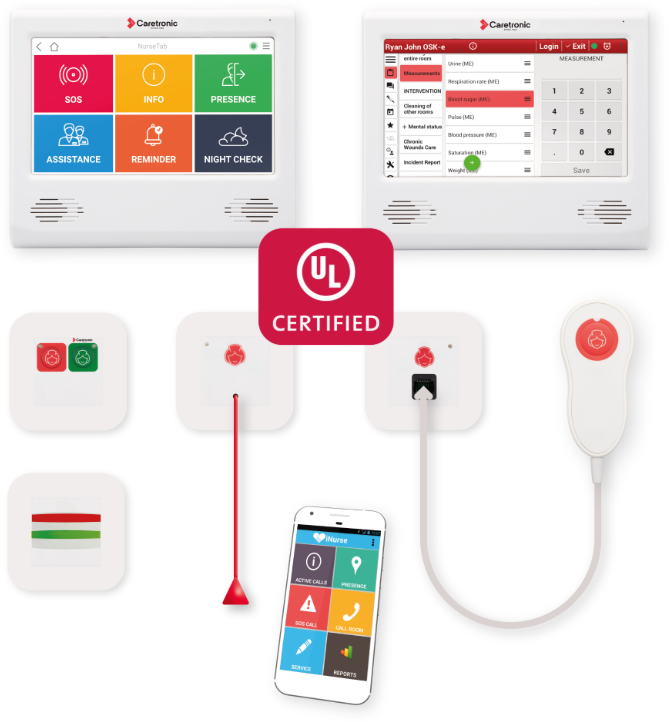
NurseCare connects these stages in one platform. The NurseTab can support communication and documentation at the point of care. Mobile and telephony connections can bring notifications to staff. Reporting turns system events into information that management can use. Sensors and optional functions extend safety beyond a manually pressed button.
This connected approach matters because staff do not experience care as a series of separate technologies. They experience one working day. Every extra login, duplicate entry, unnecessary walk or alert without context adds friction to that day.
Wired, Wireless or Hybrid: Nurse Solutions Should Fit the Building
Many nurse solutions have traditionally been wired. Wired systems remain appropriate in many healthcare settings because they provide a stable physical connection and can be designed for strict regulatory requirements. The challenge appears when an existing facility needs to replace or extend a nurse call system.
New cabling may require building work, detailed planning, room closures and coordination around residents or patients. A complete removal and replacement can therefore affect much more than the technology budget.
NurseCare can be configured as a wired, wireless or hybrid nurse call system. It can be installed in a new building, use suitable existing cabling or connect with elements of an existing installation. The right design depends on the condition of the infrastructure, applicable standards, risk assessment and the needs of the facility.
This flexibility can reduce unnecessary building work and makes phased modernisation possible. A facility does not need to choose wireless nurse solutions everywhere simply because some areas are difficult to cable. It can use the appropriate connection in each part of the building while keeping one overall hospital communication system.
NurseCare can be configured as a wired, wireless or hybrid nurse call system, while still meeting the relevant safety requirements. It is certified to DIN VDE 0834 Parts 1 and 2 and is also UL 1069 Listed. It therefore combines flexible installation with recognised safety standards for European and North American healthcare environments.
Read about NurseCare’s UL 1069 certification
An Open Platform is More Useful Than Another Isolated System
Hospitals and care homes rarely operate with one hospital communication system. They may use a hospital information system, an electronic health record, care documentation software, telephony, DECT devices, mobile applications, access control, sensors and building systems.
If each new product creates another separate data source, digitalisation can increase complexity instead of reducing it. Staff may still enter the same information more than once, while management receives only a partial view of what is happening.
NurseCare is designed as an open, IP-based platform that can exchange information with other nurse solutions through project-specific integrations. This can include primary hospital or care-management software, telephony and other authorised technologies. The purpose of integration is practical: information should move to the place where it is needed without creating another avoidable manual step. The advantage of an open platform is that the system is designed to support this instead of treating every future connection as an exception.
Software Changes What an Upgrade Can Mean
Hardware has a physical service life. Buttons, terminals, power supplies and network components must be maintained and eventually replaced. Software-led nurse solutions cannot make hardware last forever. They can, however, reduce the need to replace the complete hospital communication system whenever the organisation needs a new function.
With NurseCare, compatible software functions can be updated and new modules can be added to the platform. The organisation can improve workflows, reporting and communication without automatically starting another full infrastructure project. This separates functional development from wholesale hardware replacement wherever the installed components remain suitable. That is an important difference between simply buying newer devices and creating a foundation for continued modernisation.

Modular Nurse Solutions Allow a Realistic Starting Point
Healthcare facilities do not all have the same priorities or budget. One may need a certified core nurse call system first. Another may urgently need bedside documentation. A third may want better reporting across several locations or additional protection for residents at risk of falling or leaving a safe area.
NurseCare does not require every capability to be introduced at once. A project can begin with the nurse solutions that are needed now and expand in planned stages.
Depending on the project, this may include:
- core nurse call and emergency call functions,
- speech communication and mobile notifications,
- NurseTab bedside terminals,
- point-of-care documentation,
- response-time and call-volume reporting,
- fall, bed-exit, room-exit or other connected sensors,
- dementia safety functions,
- AI-supported communication and service functions.
Modularity is valuable only when the stages still form one coherent system. Adding unrelated products one by one can create a fragmented environment. NurseCare's approach is to let facilities expand within the same platform.
What do you need today, and what may you need in three years? A phased plan can protect the immediate budget without limiting future development.
Data Should Support Care, Not Remain Inside the Nurse Call System
Every call creates useful operational information: when it was made, where it came from, how it was routed, when staff responded and whether escalation was needed. In basic nurse solutions, these records may be used mainly for technical logs or retrospective checks. In a connected platform, they can also help managers understand daily operations.
Response-time trends, call volumes, busy periods and differences between units can support staffing discussions, workflow reviews and quality improvement. Data does not explain every situation on its own. A longer response time may reflect a complex emergency elsewhere, not poor performance. Reports should therefore support professional interpretation rather than replace it.
NurseCare brings call data and reporting into the wider hospital communication system so that information can be reviewed more easily. For groups with several care facilities, a shared approach can also make comparison more consistent.
Small Design Details Affect Daily Use
Large architecture decisions matter, but staff interact with the hospital communication system through small details. A screen must be readable. A call device must be easy to recognise and reach. Equipment must support cleaning and infection-control routines. Light and sound should provide reassurance without creating unnecessary disturbance at night.
Caretronic develops its nurse solutions around practical use in hospitals and care homes. Depending on the selected hardware, this includes touch interfaces designed for the care environment, clear visual signalling, suitable night-time orientation and surfaces intended for regular cleaning.
These features may look minor in a specification. Repeated across hundreds of calls and staff interactions, they shape whether technology feels helpful or obstructive.
AI Should Reduce Friction While Staff Remain in Control
Alarm fatigue does not come only from loud sounds. It also develops when staff receive too many notifications without enough context, including alerts that are not relevant to their role or require an avoidable trip to discover a simple request.
Caretronic is developing AI-supported nurse solutions to address specific parts of this problem. NurseVoice can add context through a structured dialogue after the standard call has already been triggered. SoundSense is designed to recognise selected distress sounds on the device, without relying on a camera or sending continuous room audio to the cloud. Speech2Service can turn a spoken service request into a structured task. SoundSense listens for distress and alerts the staff.
These functions do not replace the call, delay it or make clinical decisions. They are intended to give authorised staff clearer information, reduce unnecessary steps and support a more appropriate response. Human confirmation, configured escalation and professional responsibility remain essential. This is the practical standard that should apply to AI in nurse solutions: a defined task, a clear benefit and people still in control.
Safety, Flexibility and Evidence of Innovation
Safety certification is a starting requirement for nurse solutions, not a marketing extra. Buyers should confirm that a proposed hospital communication system and its project design comply with the standards and regulations that apply in their market.
NurseCare combines certified call functionality with an architecture intended for continued development. Its DIN VDE 0834 certification supports European call-system requirements, while UL 1069 listing addresses hospital signalling and nurse call equipment in the United States. Caretronic also develops proprietary technology and protected innovations as part of the platform.
Together, these elements show the balance that healthcare technology requires: the core must be dependable, while the surrounding platform must remain able to evolve.
NurseCare Compared with a Typical Traditional Nurse Call Configuration
The table below compares architectural approaches, not every product made by every supplier. Established vendors differ, and many advanced functions are available through optional modules, integrations or separate product families. Buyers should verify the exact proposed configuration.
| Capability | Typical traditional nurse call system | NurseCare |
| Certified, reliable nurse call | ✓ | ✓ |
| Emergency calls and prioritisation | ✓ | ✓ |
| Two-way speech options | ✓ | ✓ |
| Wired installation | ✓ | ✓ |
| Wireless or hybrid configuration | Sometimes | ✓ |
| Wireless configuration compliant with relevant safety standards | Depends on system | ✓ |
| IP-based architecture | Sometimes | ✓ |
| Integration with external systems | Sometimes | ✓ |
| Reuse of suitable existing infrastructure | Sometimes | ✓ |
| Bedside documentation on the room terminal | Sometimes | ✓ |
| Call logs and response-time reporting | Sometimes | ✓ |
| Connected safety and care sensors | Sometimes | ✓ |
| Modular expansion | Sometimes | ✓ |
| AI-supported functions | Limited or optional | ✓ |
| DIN VDE 0834 certified | Depends on system | ✓ |
| UL 1069 Listed | Depends on system | ✓ |
What Should You Compare Before Choosing Nurse Solutions?
Do not compare only the price of visible hardware. Ask how the complete hospital communication system will work over its service life:
- Which safety standards apply, and is the proposed configuration compliant?
- Can suitable cabling or existing infrastructure be reused?
- Can wired and wireless components operate as one system?
- What happens after the call reaches staff?
- Can documentation be completed in the room?
- Which information is available to the caregiver before arrival?
- Are reporting and analytics native, optional or supplied by another system?
- Which integrations already exist, and which require project work?
- Can the facility add functions gradually?
- Which upgrades require new hardware, licences or third-party products?
- How are cybersecurity, updates, maintenance and training managed?
The best nurse solutions are not necessarily those with the longest feature list. They are the ones that match the building, support the care model and can be used consistently by staff.
Why NurseCare Gives Healthcare Organisations More
NurseCare does not try to replace the fundamental purpose of a nurse call system. The call remains immediate, visible and essential. What NurseCare changes is how much value the same infrastructure can create around that call.
It can connect communication, point-of-care documentation, reporting, sensors and new software functions in one modular environment. It can be wired, wireless or hybrid. It can support new buildings, existing infrastructure and phased upgrades. Its open IP approach provides a foundation for integration and future development.
Traditional nurse solutions can be safe and capable. NurseCare's advantage is the breadth of what can be built around the safety-critical core, without forcing every facility into the same package or the same path.
If you are choosing a new nurse call system or reviewing your current hospital communication system, the useful question is not only, “Will it send the call?” It is also, “What will this system help our staff and organisation do next?”
See what NurseCare could look like in your facility. Request a free consultation or personalised demonstration.